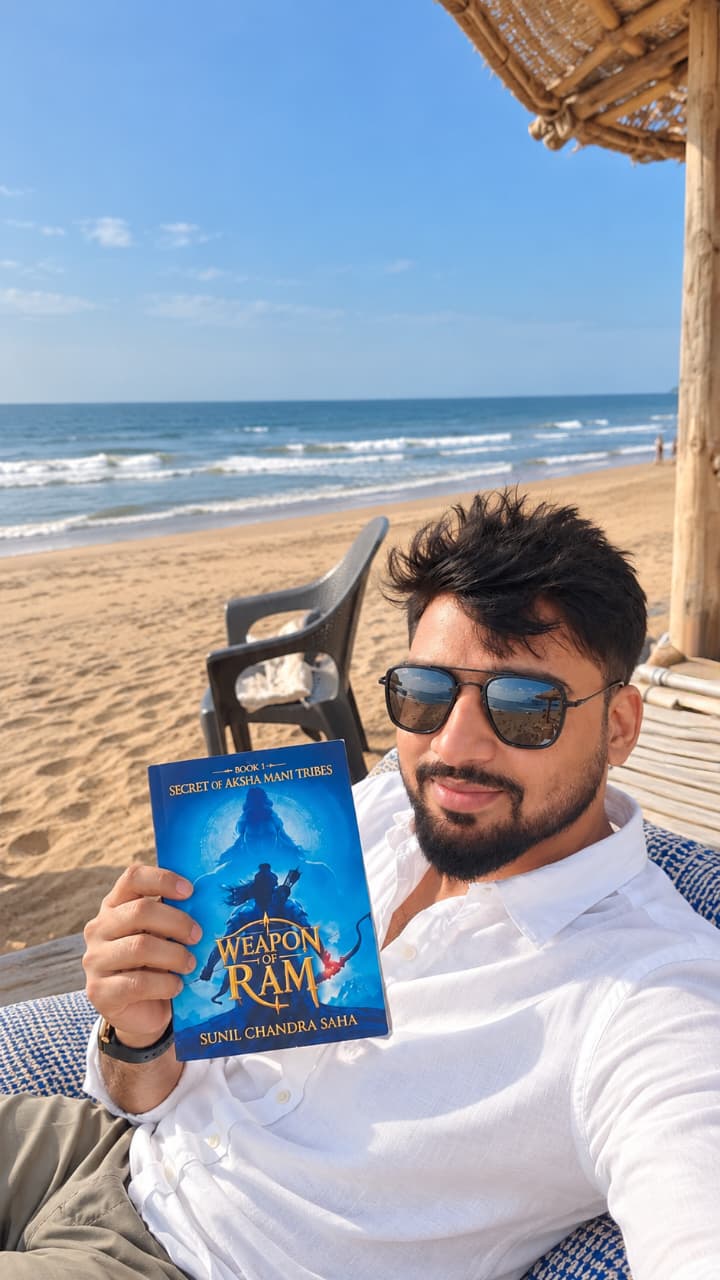
Weapon Of Ram - Trilogy
If You Loved the Shiva Trilogy, Read Weapon of Ram
November 7, 2026
·
By Sunil Chandra Saha
·
10 min read
Loved the Shiva Trilogy? See how Weapon of Ram compares: story, setting, themes, a side-by-side table and what to expect from the post-Ramayana trilogy.
Quick answer: The Shiva Trilogy and Weapon of Ram both turn an old Indian legend into a world you can walk through, so Shiva Trilogy readers often enjoy Weapon of Ram next. The Shiva Trilogy follows Shiva as a man who grows into a legend. Weapon of Ram starts after the Ramayana, around 3700 BCE, and follows five guardian tribes who protect divine weapons.
Amish Tripathi’s books made many readers return to mythology as adults. The pleasure was not only the gods. It was the feeling that an ancient story could be a fast, grounded adventure with maps, politics, secrets and a hero who has to make hard choices.
Once you close the last page, the search begins for the next book that gives the same feeling. This post is narrow. It answers one question: if you loved the Shiva Trilogy, is Weapon of Ram worth your time, and what will feel familiar or different? For a wider look at the genre, see our guide to Indian mythology fiction and our list of the best Indian mythology books.
The Shiva Trilogy has three novels: The Immortals of Meluha (2010), The Secret of the Nagas (2011) and The Oath of the Vayuputras (2013). According to the Wikipedia entry on the Shiva Trilogy, Shiva is a Tibetan immigrant and chief of the Guna tribe who moves to Meluha, an empire created by Lord Ram. His throat turns blue after he takes a medicine, and the Meluhans hail him as the Neelkanth, a legendary saviour.
The story then pulls in the Suryavanshi and Chandravanshi kingdoms, a river that is drying up, the Nagas and the drink called Somras. The author has said he sees myths as jumbled memories of a real past, and he treats the gods as figures who were once human. That idea, a god seen first as a person, is the heart of the series.
He followed it with the Ram Chandra Series: Scion of Ikshvaku (2015), Sita: Warrior of Mithila (2017), Raavan: Enemy of Aryavarta (2019) and War of Lanka (2022).
Weapon of Ram is a post-Ramayana mythology fantasy trilogy that I wrote. Book 1 is Secret of the Aksha Mani Tribes. It is set around 3700 BCE in Bharatvarsha, after Ram has defeated Ravana. The question it asks is simple: what happens to divine weapons once the war is over, and how do you stop the next person from misusing them?
This is a story idea from the trilogy, not scripture. In the novels, Ram creates a protection system built on the Aksha Mani, living stones carved from the Kaustubha Mani that emerged during the Samudra Manthan. He does this after Ravana misuses Chandrahasa. The system has four safeguards: a Power Switch, a Mantra Lock, a Living Stone and a Kill Switch. Five guardian tribes (Mountain, Jungle, Cave, Desert and Delta) each hold a fragment of the system, and someone is hunting them. You can read the traditional side in our Kaustubha Mani explainer.
The weapons carry real names from tradition, such as Kodanda, Nandaka and Chandrahasa, and you can read the traditional background in our posts on the Kodanda bow and on where Ram’s weapons are now. Their histories inside the novels are fiction. So are the Aksha Mani, the Five Tribes and characters such as Dhruv, Tara and Darukh. For the full story and cast, see the Book 1 story and characters page and the reading order.
| Question | Shiva Trilogy | Weapon of Ram |
|---|---|---|
| Author | Amish Tripathi | Sunil Chandra Saha |
| Books | 3 novels, 2010 to 2013 | 3 planned novels; Book 1 out now |
| Starting point | Shiva as a tribal chief who becomes the Neelkanth | The world after Ram defeats Ravana |
| Time of the story | An ancient, imagined Meluha | Around 3700 BCE, after the Ramayana |
| Central idea | A god seen first as a man | What to do with divine weapons after the war |
| Journey | Meluha, the Nagas and the Vayuputras | Kailash, Indraprastha, Kannauj, Takshila, Parsa (Persia), Egypt and Kerala |
| Link to Ram | Meluha is an empire created by Ram | Ram builds the weapon-protection system |
| Series status | Complete | Book 2 due Diwali 2026; Book 3 due Diwali 2027 |
The Shiva Trilogy is about one man’s rise, so the reader stays close to Shiva. Weapon of Ram is built around a system and the people who guard it, so the story moves between tribes and places. The Shiva Trilogy is also finished, while Weapon of Ram is still unfolding. If you like to read a complete series in one run, you may want to start with Book 1 and wait for Books 2 and 3.
Tone is another difference. I wanted the weapons to feel like something with weight, a responsibility rather than a trophy. That is a personal taste of mine, not a rule of the genre. If you want to see how I think about the Ramayana itself, our post on what happened after the Ramayana separates what scripture says from what later retellings add.
You may enjoy it if you liked the mix of mythology and mystery, if you are curious about the part of the Ramayana story that scripture only touches lightly, or if you enjoy travelling across a map of ancient places in one novel. The route runs from Kailash to Persia and Egypt before returning to Kerala.
You may enjoy it less if you want a book that follows scripture line by line. Weapon of Ram is inspired by the Ramayana. It is not a retelling, and it does not claim to be scripture. If that difference matters to you, read the epic itself first. Our post on the astras Vishwamitra gave Ram is a good starting point for the scripture side.
I am Sunil Chandra Saha, an author from Bengal and co-founder of Blue Tea, and I wrote this trilogy for readers who love the Ramayana and wonder what came next. Book 1, Secret of the Aksha Mani Tribes, is available now in print on Amazon India and Flipkart, and as a Kindle edition in 12 countries. Book 2, Raavan of Persia, is scheduled for Diwali 2026, and Book 3, Rebel Gods of Pyramids, for Diwali 2027. You can read the plan on the Raavan of Persia page, the trilogy overview, the Book 1 page and the FAQ.
They share a love of turning legend into a lived-in world, with quests, secrets and invented peoples. They differ in focus. The Shiva Trilogy follows one man who becomes the Neelkanth, while Weapon of Ram follows the guardians of divine weapons after the Ramayana.
They are The Immortals of Meluha (2010), The Secret of the Nagas (2011) and The Oath of the Vayuputras (2013), all by Amish Tripathi.
If you want more by the same author, the Ram Chandra Series is the natural next step. If you want a different voice, try other Indian mythology novels, or Weapon of Ram if you are curious about the story after the Ramayana.
The trilogy is set around 3700 BCE in Bharatvarsha, after Ram defeats Ravana. This is the trilogy’s own setting and a story idea, not scripture.
No. Ram, Ravana and Hanuman appear, but the story introduces the Aksha Mani, the five tribes and the new characters as it goes, so a basic knowledge of the epic is enough.
Not yet. Book 1 is available now, Book 2, Raavan of Persia, is scheduled for Diwali 2026, and Book 3, Rebel Gods of Pyramids, for Diwali 2027.
The print edition is on Amazon India and Flipkart, and the Kindle edition is available in 12 countries.
The names, such as Kodanda, Nandaka and Chandrahasa, come from tradition. Their histories in the novels, and the Aksha Mani system that protects them, are the author’s fiction.
Sources: Wikipedia entries on the Shiva Trilogy and Amish Tripathi; the Weapon of Ram book and FAQ pages on this site.
Ready to Enter the World of Ram?