Weapon Chronicles
Pushpak Viman: How Ram Returned to Ayodhya and Where It Is Now
November 10, 2026
·
By Sunil Chandra Saha
·
9 min read
Pushpak Viman explained: how Ram flew back to Ayodhya, why it returned to Kubera, and what is known about where it is now. A Diwali special.
Quick answer: The Pushpak Viman, or Pushpaka Vimana, is the flying chariot that carried Ram, Sita, Lakshmana and their companions from Lanka back to Ayodhya after the war. In the Valmiki Ramayana, Ram then tells it to return to its original owner Kubera, and it flies north. No verified evidence shows where it is now.
Diwali note: Diwali 2026 fell on 8 November, the festival that tradition links to Ram’s homecoming. The site’s FAQ lists Book 2 of the Weapon of Ram trilogy, Raavan of Persia, for Diwali 2026. Check the Raavan of Persia page for the latest update on purchase links.
The Pushpak Viman is the best-known aerial car in Indian tradition. The word vimana means a flying vehicle or a palace, and Pushpaka is its name. According to the Wikipedia entry on the Pushpaka Vimana, Vishvakarma, the divine architect, made it for Brahma. Brahma later gave it to Kubera, the god of wealth.
Ravana, who was Kubera’s half-brother, took it. In the Uttara Kanda account, Ravana defeated Kubera, looted his city of Alaka and flew home in the Pushpaka. That is how the vimana ended up in Lanka. Ram sent it back after the war.
The war ended, Vibhishana was given Lanka and the exile of fourteen years was coming to a close. Ram, Sita, Lakshmana, Sugriva and others boarded the Pushpaka and flew to Ayodhya. On valmikiramayan.net this journey is described in Yuddha Kanda, Sarga 123. Along the way, Ram points out landmarks to Sita: Lanka and the bridge across the ocean, Mount Rishyamuka, the Pampa river, Panchavati, the ashrams of Agastya, Atri and Bharadwaja, the Godavari, Chitrakuta, the Yamuna, the Ganga and the Sarayu. The chapter ends with Ayodhya in sight.
Sita also asks that the wives of the monkey chiefs be brought along, and Ram agrees. It is a gentle moment in the middle of a great epic, and I have always liked how the aerial car becomes a way to retell the whole journey in one sweep.
In Yuddha Kanda, Sarga 127, Bharata hears from Hanuman that Ram is returning and orders Shatrughna to prepare Ayodhya. Bharata and the citizens go to Nandigrama. When the Pushpaka lands, Bharata greets Ram, and he sets Ram’s wooden sandals at his feet. Ram honours his mothers and then tells the Pushpaka to go back to Kubera, its first owner. The aerial car flies north to Kubera’s abode.
| Stage | What happens | Source layer |
|---|---|---|
| Creation | Vishvakarma makes the Pushpaka for Brahma | Tradition, as summarised on Wikipedia |
| First owner | Brahma gives it to Kubera, god of wealth | Tradition, as summarised on Wikipedia |
| Taken by Ravana | Ravana defeats Kubera and takes the vimana along with Lanka | Uttara Kanda account |
| Sita’s abduction | Ravana’s vehicle in the Aranya Kanda is drawn by mule-like animals; Wikipedia cites Sargas 31, 42 and 51 | Aranya Kanda |
| Journey home | Ram, Sita and companions fly from Lanka to Ayodhya | Yuddha Kanda, Sarga 123 (valmikiramayan.net numbering) |
| Return to Kubera | Ram tells the Pushpaka to fly north to Kubera | Yuddha Kanda, Sarga 127 (valmikiramayan.net numbering) |
| Today | No verified evidence of its location | Modern claims, unverified |
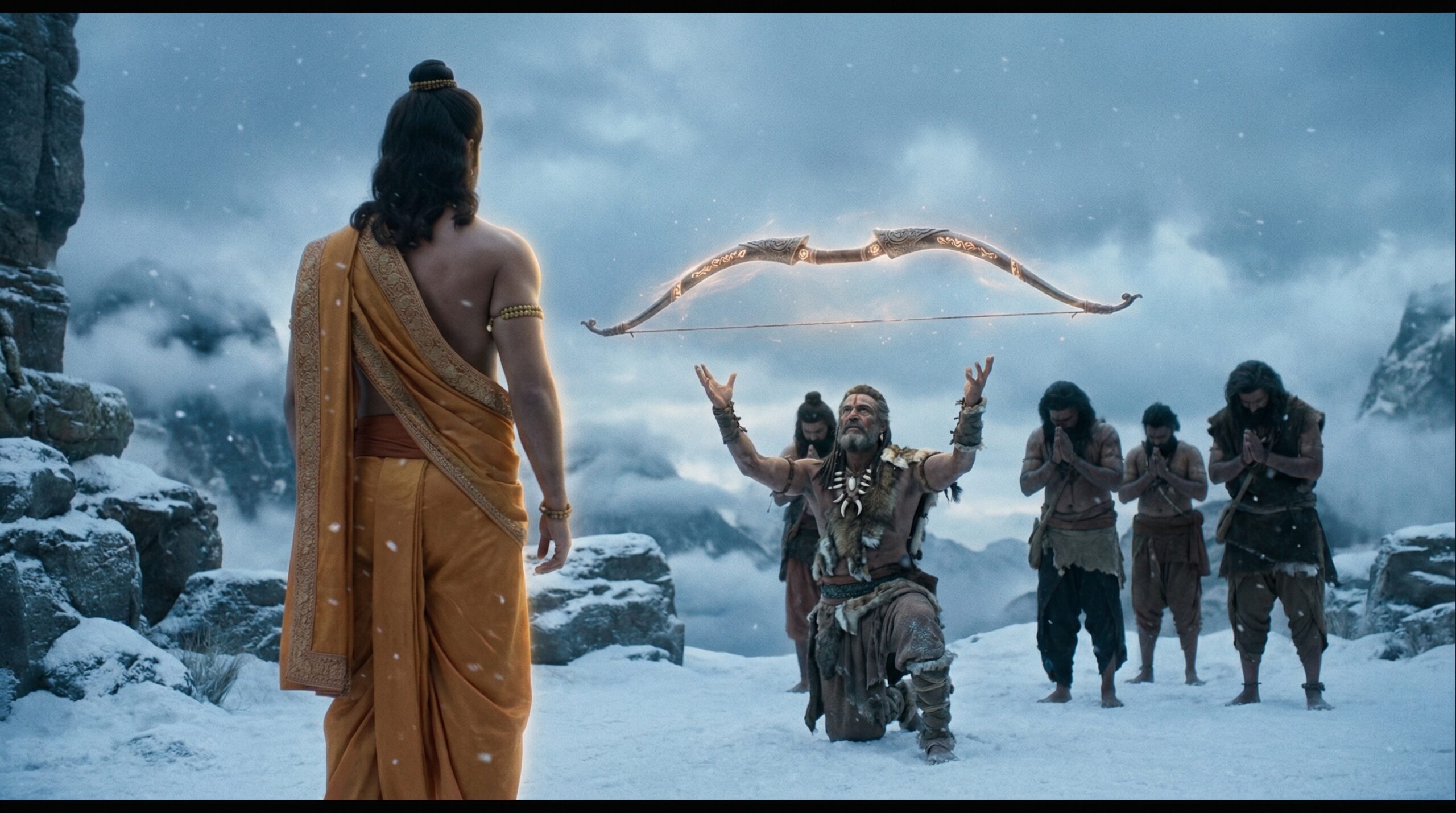
The Valmiki Ramayana gives only one answer. The Pushpaka went back to Kubera. The text tells us it flew north to his abode, and that is the last we hear of it in the main story. After that, nothing in Valmiki follows the vimana.
Many modern claims go beyond that. I want to be careful here, because some people say the Pushpaka is real and some say it is only poetry. The honest answer is that no verified physical evidence has been found. If you see a claim about hidden remains of an ancient aircraft, please ask for the source.
The Vaimanika Shastra is an early 20th-century text on aeronautics that is often quoted in this debate. According to Wikipedia, G. R. Josyer published it in 1952, and a 1974 study at the Indian Institute of Science called the aircraft it describes “poor concoctions”. It was written long after the Ramayana and should not be used as evidence about the Pushpaka.
Yes. Wikipedia notes that the Ayyavazhi text Akilattirattu Ammanai says a Pushpak Viman carried Ayya Vaikundar to Vaikundam, and that a Pushpak Viman shaped like an eagle is said to have taken the saint Tukaram to heaven bodily. These are devotional traditions, separate from the Ramayana, and they show how the name came to stand for a divine vehicle. The word vimana also survives in the name of Bangladesh’s national airline, Biman.
Tradition links Diwali to Ram’s homecoming. As we say in our post on what happened after the Ramayana, this link is a living custom and not a single documented account in the text. Ayodhya welcomes Ram, lamps are lit and the festival remembers the return. I do not claim more than that. Different regions and communities observe Diwali for different reasons, and I respect all of them.
This is a story idea from the trilogy, not scripture. The Pushpak Viman is not one of the safeguards of the Aksha Mani system, and I do not want to pretend that the trilogy says more about it than it does. The connection is in the question both stories ask. After the war, what happens to the great instruments of power? The Pushpaka goes back to its rightful owner. In the trilogy, Ram goes further and builds the Aksha Mani system so that divine weapons are locked and guarded. The Aksha Mani are living stones carved from the Kaustubha Mani. If you are curious about the jewel, read our post on the Kaustubha Mani.
For more on the world after the war, see our guide to post-Ramayana fiction, the guide to Ravana’s weapons and the Weapon of Ram reading order.
I am Sunil Chandra Saha, an author from Bengal and co-founder of Blue Tea. Weapon of Ram is a post-Ramayana mythology fantasy trilogy set around 3700 BCE. Book 1, Secret of the Aksha Mani Tribes, is available now in print on Amazon India and Flipkart, and as a Kindle edition in 12 countries. The FAQ lists Book 2, Raavan of Persia, for Diwali 2026 and Book 3, Rebel Gods of Pyramids, for Diwali 2027. The route runs from Kailash to Persia, Egypt and Kerala. See the Book 1 page and the FAQ for the latest status.
It is the flying chariot of Indian tradition. Vishvakarma made it for Brahma, Brahma gave it to Kubera, Ravana took it, and Ram used it to return from Lanka to Ayodhya.
According to tradition as summarised on Wikipedia, Vishvakarma, the divine architect, made it for Brahma.
In the Valmiki Ramayana, Ram, Sita, Lakshmana and their companions flew from Lanka to Ayodhya in the Pushpaka Vimana. The journey is told in Yuddha Kanda, Sarga 123 on valmikiramayan.net.
Ram told it to return to Kubera, and it flew north to Kubera’s abode (Yuddha Kanda, Sarga 127 on valmikiramayan.net). The main epic does not follow it after that.
No verified physical evidence exists. It is a vehicle of the epic and of tradition. Claims that it was a real aircraft are not supported by evidence.
It is an early 20th-century text that was published in 1952. A 1974 study at the Indian Institute of Science called its aircraft poor concoctions.
Tradition links Diwali to Ram’s homecoming to Ayodhya, which the Ramayana tells as a journey by the Pushpaka. The link is a living custom, not a single documented account.
The site’s FAQ lists it for Diwali 2026. Check the Raavan of Persia page on this site for the latest status.
Sources: Wikipedia on the Pushpaka Vimana; Yuddha Kanda Sargas 123 and 127 on valmikiramayan.net; the Weapon of Ram book page and FAQ on this site.
Ready to Enter the World of Ram?