Weapon Chronicles
All the Astras Vishwamitra Gave Ram: The Complete List from the Bala Kanda
October 29, 2026
·
By Sunil Chandra Saha
·
11 min read
Weapons Vishwamitra gave to Ram in the Valmiki Ramayana: the full astra list, how Ram used them on Maricha and Subahu, and what is story, not scripture.
Quick answer: In the Valmiki Ramayana, the sage Vishwamitra gave Ram a very large set of divine weapons, about fifty named in all, after Ram killed Tataka. They include the Dandachakra, Dharmachakra, Kalachakra and Vishnu chakra, the Brahmastra and Brahmashira, Shiva’s trident, the Pinaka and Narayana missiles, the maces Modaki and Shikhari, three nooses and many more. Vishwamitra also taught Ram how to call back (withdraw) the weapons.
Ask ten people which weapons Vishwamitra gave Ram and you will get ten different answers. Some say only the bow Kodanda. Others say the Brahmastra. The Bala Kanda is far more detailed than that. It gives a long, named list, and it tells us when the gift was made, why, and how Ram used it within days. This post goes through that list step by step, using the Valmiki Ramayana as the base and marking clearly where later retellings or the Weapon of Ram trilogy add their own ideas.
Vishwamitra came to King Dashrath’s court to ask for Ram and Lakshman, because demons kept spoiling his yajna. On the way they met Tataka in her forest, and Ram killed her. You can read that story in our post on Tadka Vadh and Ram’s first test.
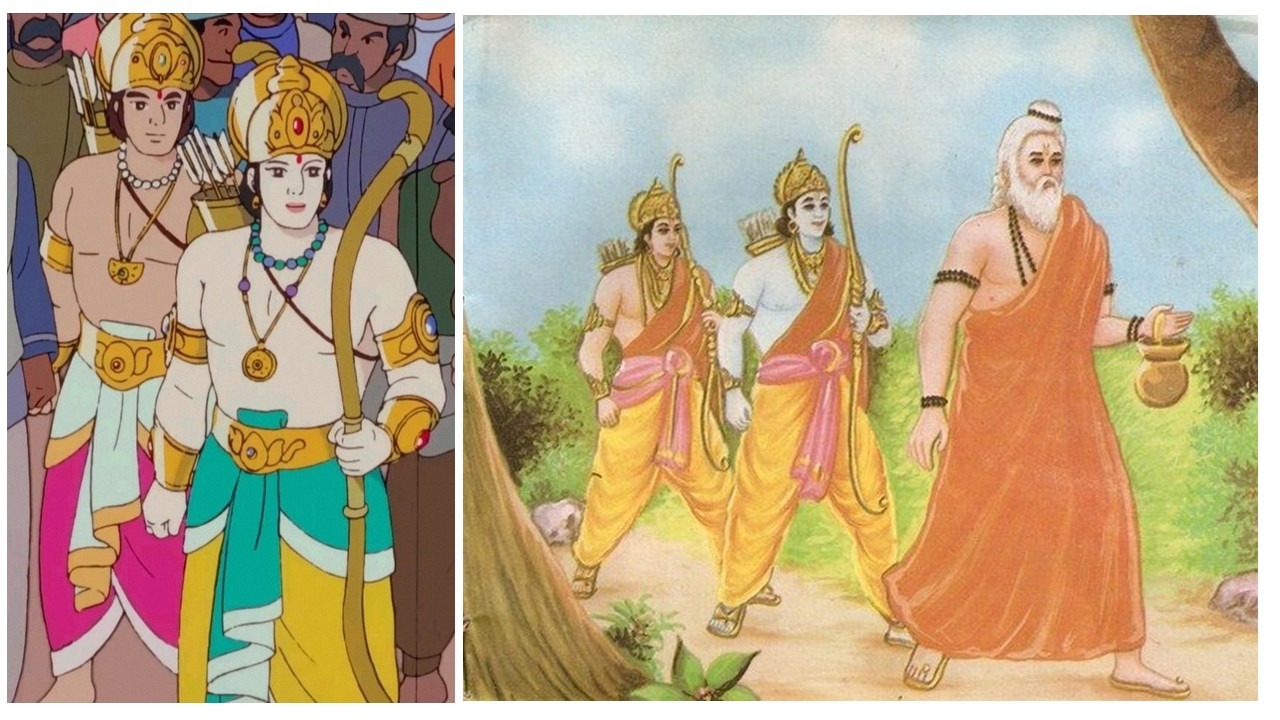
The Bala Kanda says that Vishwamitra spent that night in the Tataka forest. The next morning he told Ram, smiling, that he was highly pleased with him. After purifying himself and facing east, he handed over the divine weapons through mantras (sarga 27). The reason is plain in the story. Ram was about to guard a yajna against Maricha, Subahu and their followers, and the larger fight with Ravan was still ahead. Vishwamitra was preparing him for both. Our video post on Vishwamitra’s test for Ram and Lakshman looks at the same turning point.
The prose translation of sarga 27 on valmikiramayan.net names roughly fifty weapons. Translators group and count them differently, so treat any single number with care. The table below groups them by kind. The names are as given in that translation; other translations spell them differently.
| Kind of weapon | Names in the Bala Kanda list | What the text says |
|---|---|---|
| Discs (chakras) | Dandachakra, Dharmachakra, Kalachakra, Vishnu chakra, Indra chakra | Named as the first gifts. The translation does not describe each disc in detail. |
| Great missiles | Brahmashira, Brahmastra, Aishika, Vajra (thunderbolt), Shiva’s trident (shula), Pinaka, Narayana | The Aishika is a blade of grass that becomes a missile when charged with mantras. |
| Maces | Modaki, Shikhari | Two maces, named in the list. |
| Nooses (pasha) | Dharmapasha, Kalapasha, Varunapasha, plus the Varuna astra | Binding weapons linked to dharma, time and Varuna, the rain god. |
| Elemental missiles | Shushka (drier), Ardra (drencher), Agneya (fire), Vayavya (air) | Their names describe their effect. The Agneya and Vayavya both appear again in sarga 30. |
| Other named weapons | Hayashira, Krauncha, two Shaktis, Kankala, Kapala, Kankana, the sword Nandana | Several are described as weapons against demons. |
| Effect-based astras | Mohana, Prasvapana (sleep), Prashamana (calming anger), Varshana, Shoshana, Santapana, Vilapana, Madana, Manavastra, Paishacha | Many work on the mind or the body: stupefying, sending to sleep, drying, causing grief. |
| Astras of the gods | Teja-prabha (solar), Shishira (moon), Sudamana (Tvashta), Shiteshu (Bhaga), the missile of Manu | Linked by the text to Surya, Soma, Tvashta, Bhaga and Manu. |
A few points are worth stating clearly. First, the list is long and layered: it mixes discs, maces, nooses, divine missiles and weapons that act by their effect. Second, many entries are only names. The Bala Kanda does not explain each one, so anyone who gives you a neat paragraph on every item is drawing on later texts or on imagination. Third, the sarga has no bow in the list as I read it, so where you hear that Vishwamitra “gave Ram his bow”, you are hearing a later telling or a tradition. We cover that tradition in our post on Kodanda, Ram’s bow.
Yes, in the Bala Kanda list. The Brahma astra and the Brahmashira are both named among the gifts. This often surprises readers, because a popular idea says Ram received the Brahmastra only later. The Ramayana does describe further gifts in the Aranya Kanda, when the sage Agastya gives Ram more weapons, including Vishnu’s bow. So the two statements fit together: Vishwamitra gave the first and largest set, and later sages and gods added to it.
Receiving a weapon is not the same as knowing it. According to sarga 28, Ram also learned the annulment missiles, the knowledge of drawing a weapon back after it is invoked. The text then shows the weapons appearing in divine forms, with bright bodies and folded hands, and telling Ram they are ready to serve him. Ram asks them to stay in his memory and come when he calls, and they leave after circling him.
Vishwamitra also named the “children of Krishashva”, a second list of forty-nine astras that includes Satyavanta, Satyakirti, Dhrishta, Rabhasa, Lakshya, Alakshya, Jrimbhaka and others. The prose translation breaks off that list with an ellipsis, so we do not know from that text alone whether more names follow.
The first test comes quickly. After Ram and Lakshman guard the yajna for six days and nights, Maricha and Subahu attack on the sixth night (sarga 30). The text shows three of the gifts in action.
| Target | Weapon Ram uses | Result |
|---|---|---|
| Maricha | Manavastra | Maricha is thrown far into the ocean but not killed. |
| Subahu | Agneyastra (fire missile) | Subahu is struck down and dies. |
| The other demons | Vayavyastra (missile of the wind god) | The rest are destroyed and the yajna is completed. |
Notice what Ram does not do. He spares Maricha. Our post on Maricha and the fight with Khar and Dushan follows that thread forward. Maricha returns later as the golden deer in the Aranya Kanda. In the epic, the weapons come with restraint attached.
The weapons of the Ramayana attract a lot of loose claims, so it helps to keep three layers apart. The table gives the simple rule I follow.
| Layer | What belongs here | Example |
|---|---|---|
| Scripture (Valmiki Ramayana) | The named gift in sarga 27 and 28, and the use in sarga 30 | Vishwamitra gives Ram the Brahmastra, the chakras and the Pinaka missile; Ram uses the Agneyastra on Subahu. |
| Later or regional retellings | Extra detail, new names, powers and stories added by later writers | Descriptions of each astra’s mantra, form and power. |
| Story idea from the trilogy | Original fiction built on the epic | What happened to Ram’s weapons after the war. This is a story idea from the trilogy, not scripture. |
If you want to see how the epic’s magic works as a system, our post on Valmiki’s magic system decoded goes deeper. For the question of what became of the great weapons after the war, read where Lord Ram’s weapons are now. For the other famous bow in the story, see which bow Ram broke to marry Sita.
This episode from my Ramayana series looks at why Vishwamitra took Ram and Lakshman into the forest, the tests they faced, and how that training prepared Ram for the battles ahead. It also introduces Kodanda, Nandaka and the divyastras. Watch it alongside this post if you like to hear the story told aloud.
The Weapon of Ram trilogy begins where the Ramayana ends. Each book is built around a divine weapon, and the three weapons at the centre are Kodanda, Nandaka and Chandrahasa. Their guardians and rules are my own story ideas, not scripture. The Valmiki Ramayana does not mention the five guardian tribes or the Aksha Mani, the living stones that act as keys to the weapons. In the novel, Ram asks how the weapons he used can be kept from the wrong hands, and the Aksha Mani system is the answer.
The Vishwamitra list is part of why I wrote the story. When a sage hands a young prince this much power, the next question is who looks after it later. That question is where the trilogy starts. You can read more on the Weapon of Ram Book 1 page and in the FAQ. Book 1 is available in print and on Kindle.
In the Valmiki Ramayana he gave roughly fifty named weapons. They include the Dandachakra, Dharmachakra, Kalachakra, Vishnu chakra, Indra chakra, the Brahmastra and Brahmashira, Shiva’s trident, the Pinaka and Narayana missiles, the maces Modaki and Shikhari, three nooses, and many astras that act by their effect.
He gave them the morning after Ram killed Tataka, while they were still in her forest. This is in the Bala Kanda, sarga 27.
Yes. The Brahma astra and the Brahmashira are both named in the Bala Kanda list. The sage Agastya gives Ram further weapons later, in the Aranya Kanda.
The Bala Kanda list, as translated on valmikiramayan.net, names no bow. Some retellings and traditions link Kodanda to Vishwamitra, so treat that as a later telling rather than the Valmiki text.
He used the Manavastra on Maricha, the Agneyastra on Subahu and the Vayavyastra on the remaining demons. This is in sarga 30.
They are a second list of astras that Vishwamitra names to Ram in sarga 28, such as Satyavanta, Satyakirti, Rabhasa and Jrimbhaka. The text personifies them as bright beings who offer to serve Ram.
No. The trilogy builds an original story around Kodanda, Nandaka and Chandrahasa. Their guardians and rules are the author’s own story ideas, not scripture.
Sources: the Valmiki Ramayana, Bala Kanda sarga 27, 28 and 30 (prose translation on valmikiramayan.net); the Weapon of Ram Book 1 and FAQ pages on this site.
Ready to Enter the World of Ram?